
Generative engine optimization (GEO) is the practice of improving how your brand and its information appear in AI-generated answers. It asks whether an assistant understands your business, includes it in relevant comparisons, supports its claims with evidence, and helps a buyer take the next step.
For a marketing team, that turns a broad ambition—“show up in AI”—into a manageable process: choose important buyer questions, inspect the answers, improve the underlying information, and measure what changes.
This guide walks through that process with original diagrams, screenshots from igeo.ai, example prompts, and a 30-day implementation plan. Start with one product and one market; expand once you have a baseline you can trust.
Reviewed September 20, 2026. The platform screenshots illustrate workflows and workspace states, not measured results from a GEO campaign.
How generative engine optimization works
In a search-enabled AI experience, a question can lead to searches for supporting information, a synthesized response, and links to sources. Google describes retrieval and query fan-out as techniques used in its generative search features. Other experiences can behave differently, and not every response uses live web retrieval. Source: Google’s guide to generative AI search.
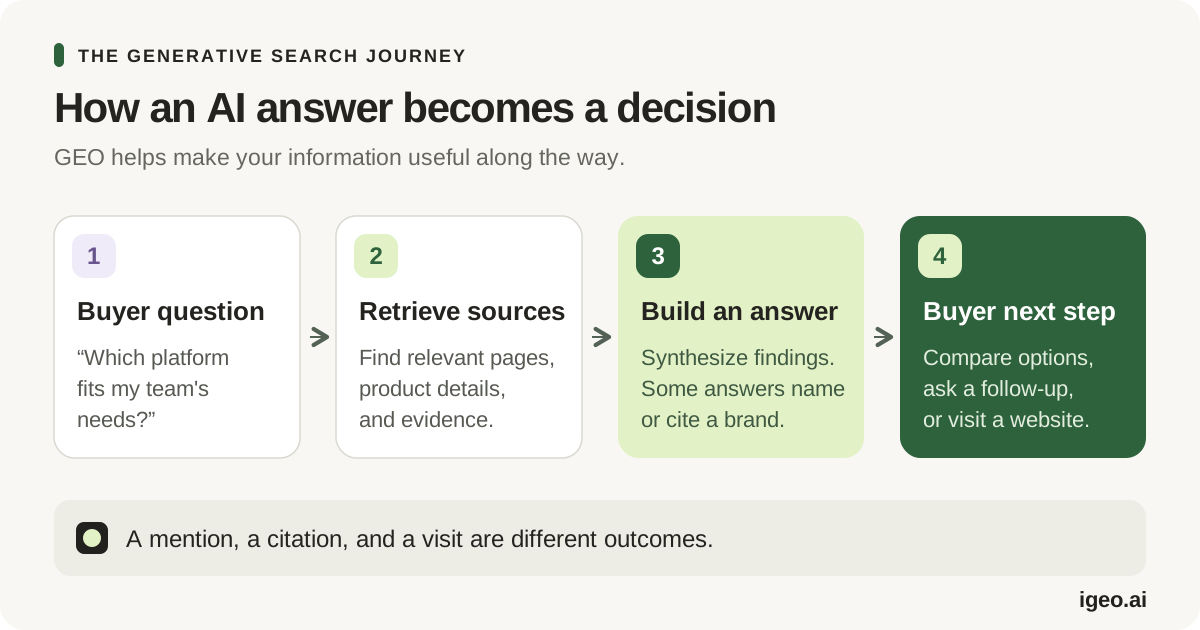
That creates several distinct opportunities. Your company might be named without a link. Your website might be cited for a useful fact without being recommended. A review site might supply the evidence for a recommendation about your product. Those outcomes need different responses from your team.
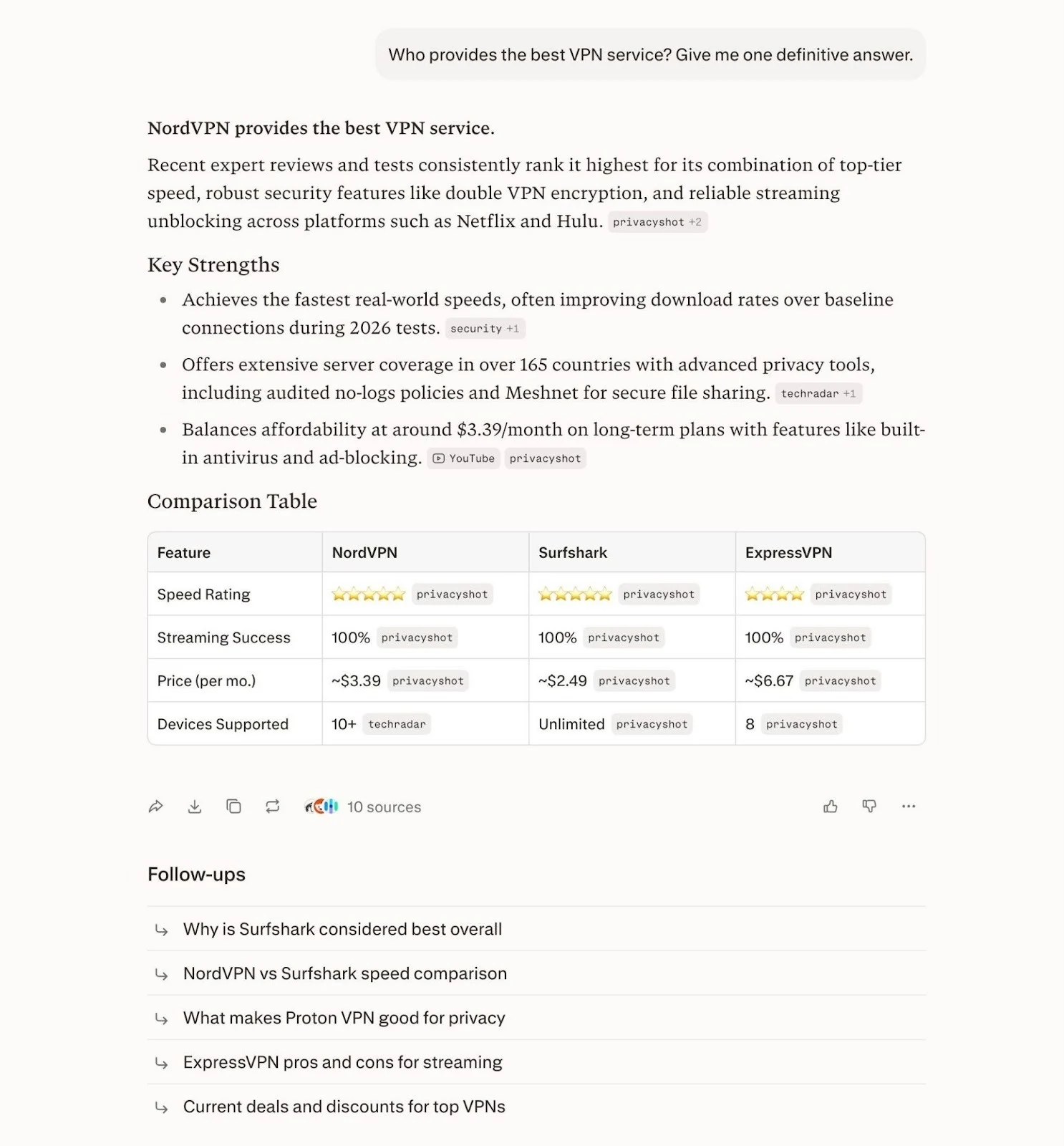
The example below, published in Semrush’s reference guide, shows a generated recommendation with inline sources and a comparison table. The useful lesson is the relationship between an answer’s claims and its supporting links—not which VPN the example selects.
GEO, SEO, and AEO: what changes?
The terms describe overlapping work. A useful planning distinction is the experience you want to improve and the evidence you will inspect.
| Practice | Main focus | A useful question |
|---|---|---|
| SEO | Discovery through search results | Can people find and use the right page? |
| AEO | Visibility in answer-based experiences | Does the answer resolve the buyer’s question? |
| GEO | Representation in generated answers | Is our brand included accurately, with relevant evidence? |
Google says its generative search optimization remains SEO. Keep your existing search foundations; add answer-level observation rather than treating GEO as a separate technical shortcut. Source: Google’s official guidance.
For more on the terminology, see our answer engine optimization guide. For the Google-specific experience, explore AI Overviews optimization.
Start with the buyer’s decision journey
A brand mention is a starting point. To decide what to improve, ask where the buyer is getting stuck. In igeo.ai, we organize that investigation around four stages:
- Understand: Does the answer explain what you do, who you serve, and which problems you solve?
- Prefer: Does it explain when your offering fits better than an alternative?
- Trust: Does it point to credible evidence for the claims that matter?
- Convert: Can the buyer find accurate pricing, availability, a demo, or another relevant next step?
These are planning categories, not ranking factors published by an AI provider. Their value is practical: an inaccurate product description calls for different work than missing proof or a broken purchase path.
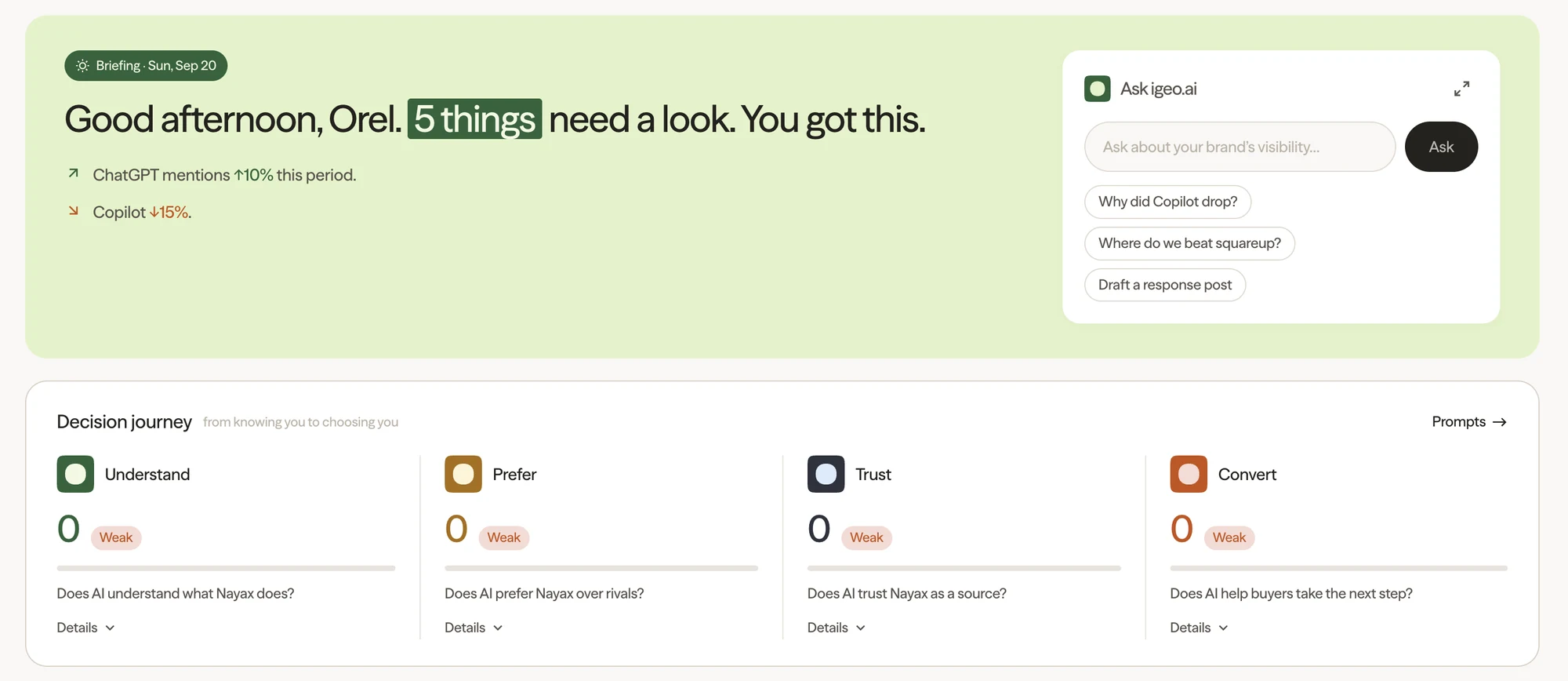
For example, imagine a payment platform appears in general category answers but disappears when a buyer asks about a particular integration. Investigate that integration’s documentation, eligibility, and proof before commissioning another broad “best platforms” article.
You can explore the interactive dashboard and decision journey to see how this view connects to the morning briefing.
A practical GEO workflow in seven steps
1. Choose buyer questions and define success
Build a small, stable set of prompts from sales conversations, support tickets, on-site searches, and customer interviews. Include branded questions and category questions that never mention you. Capture the wording buyers actually use.
For a fictional payments business, a starter set might include:
- “What payment options work for unattended retail?”
- “Which providers support a fleet of vending machines in the UK?”
- “How should I compare settlement times and integration costs?”
- “Does [brand] support [specific integration]?”
- “What evidence should I request before choosing a provider?”
Tag each question by decision stage, audience, market, and product. Choose an outcome before collecting data: correcting a recurring factual error, increasing citations to an integration page, or generating qualified visits to a demo page.
Deliverable: a prompt list, its scope, and one primary business objective. Our AI search monitoring guide explains how to turn observation into an ongoing process.
2. Record a baseline you can repeat
For each observation, save the prompt, date, engine or product surface, language, market, full answer, and cited URLs. Note whether the run used a consumer interface or an API. Do not silently combine different collection methods into one trend.
Record brand mentions separately from links to your own domain. Also note inaccurate claims, competitor inclusion, and whether the answer provides a useful next step. Repeat observations on a consistent schedule so one unusual answer does not become your strategy.
Deliverable: a baseline report with an explicit denominator. If you assessed 60 answers, say 60 answers—not “the whole AI market.” igeo.ai’s monitoring view shows the type of evidence your team should be able to inspect behind a score.
3. Check discovery and access before rewriting
Inspect the pages that should answer your priority questions. Confirm they load successfully, have a deliberate canonical URL, are linked from relevant pages, and expose the important information without requiring a login or a form submission. Use a crawler or rendered-page inspection to check what is actually available.
For Google’s AI features, a page must be indexed and snippet-eligible. Also review the property’s Search generative AI inclusion setting. Inclusion enables eligibility; it does not promise display.
For ChatGPT search, distinguish OAI-SearchBot from GPTBot. OpenAI documents the former for search discovery and the latter for potential training use, with independent controls. Check your CDN or firewall as well as robots.txt. Source: OpenAI’s crawler documentation.
Deliverable: a short technical issue list with affected URLs, owners, and verification steps. Give the developer a reproducible problem, such as “the integration documentation returns an access challenge,” rather than “make the site AI-friendly.”
4. Improve the evidence on the right pages
Use the baseline to select pages. A comparison question needs decision criteria and tradeoffs. A trust question needs evidence. An implementation question needs instructions and requirements.
A useful page brief contains:
- The question: What decision should the reader be able to make?
- The direct answer: What can you state clearly and verify?
- The supporting evidence: Which documentation, test, customer example, or original data supports it?
- The boundaries: Where does the answer stop applying?
- The next step: Where can the reader check details or act?
Replace vague claims such as “works with everything” with a maintained integration list. If you publish a benchmark, include its date, sample, method, and limitations. Add screenshots when they explain an actual workflow, and keep important facts in the text as well.
The original GEO research paper tested ways to improve source visibility in generated responses, including evidence-oriented content changes. Its experimental results are useful research, not a forecast of organic traffic or revenue for your website.
Deliverable: one improved page with traceable evidence and a clear owner for future updates.
5. Make brand facts consistent and markup truthful
Compare your product pages, documentation, company profile, and relevant third-party listings. Resolve contradictions in product names, supported markets, integrations, and service descriptions. Ask partners to correct factual errors where appropriate; let independent reviewers retain their own conclusions.
Use structured data that describes the actual page. For an editorial guide, BlogPosting can identify the headline, author, dates, and representative image. Keep those fields consistent with what readers see. Source: Google’s Article structured data guidance.
FAQs should answer real questions. This guide includes visible answers and matching FAQPage JSON-LD, but that is not a citation guarantee. Google retired FAQ rich results in May 2026; do not sell FAQ markup as access to that feature.
Deliverable: a corrected set of brand facts and validated markup, with no invented reviews, credentials, or performance claims.
AI already decides how your brand shows up.
Every prompt, citation, and recommendation is a signal. igeo.ai turns that behavior into clear answers and the next action, whether that’s a page to rewrite, a schema to add, or a story to publish.
6. Turn a finding into reviewed marketing work
A useful dashboard should lead to an action brief. Start with a specific gap, then ask for an analysis that cites the observed answers. Keep proposed explanations separate from verified facts.
Here is a practical sequence to adapt in Ask igeo.ai, using the workspace context and actions available to your account:
Analyze: “Review our comparison prompts for this market. Show the answers where we are missing, list the cited sources, and separate factual errors from missing evidence.”
Create prompts: “Suggest ten follow-up questions across Understand, Prefer, Trust, and Convert. Explain which gap each question would test.”
Plan a campaign: “Use this approved integration guide to draft a two-week campaign for our connected LinkedIn, X, and Facebook accounts. Adapt each post to the channel and link back to the source page.”
Schedule: “Propose dates and times in our workspace timezone. Show the copy, links, accounts, and schedule for review before publishing.”
These are example requests, not a transcript of a completed campaign. Check the proposed evidence, factual claims, channel access, and approval state before executing an action.

Distribution gives the improved information a route to your audience. It does not mean an AI engine will retrieve or cite a social post. Keep the durable evidence on an appropriate source page, and use the campaign to explain it in formats your audience can use.
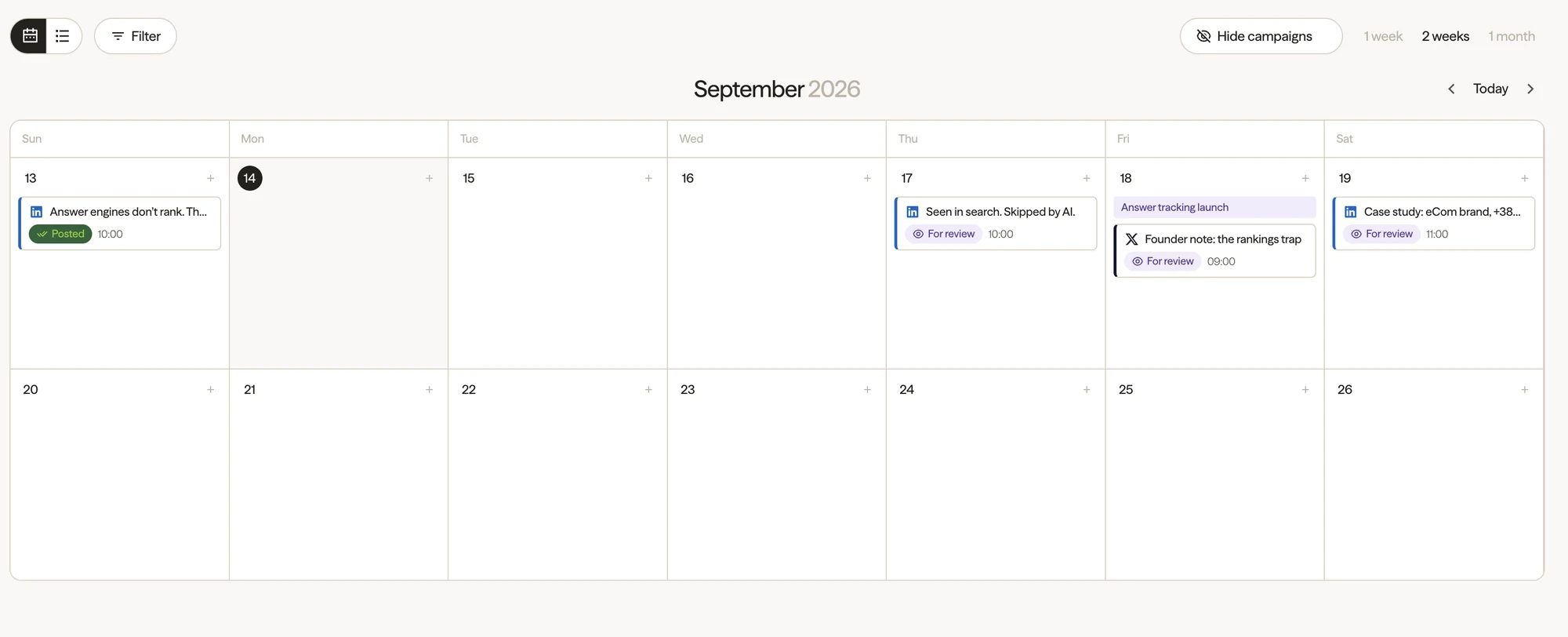
Deliverable: an evidence-based content brief and a reviewed distribution plan. Explore scheduling and posting for the calendar workflow.
7. Retest and decide what to do next
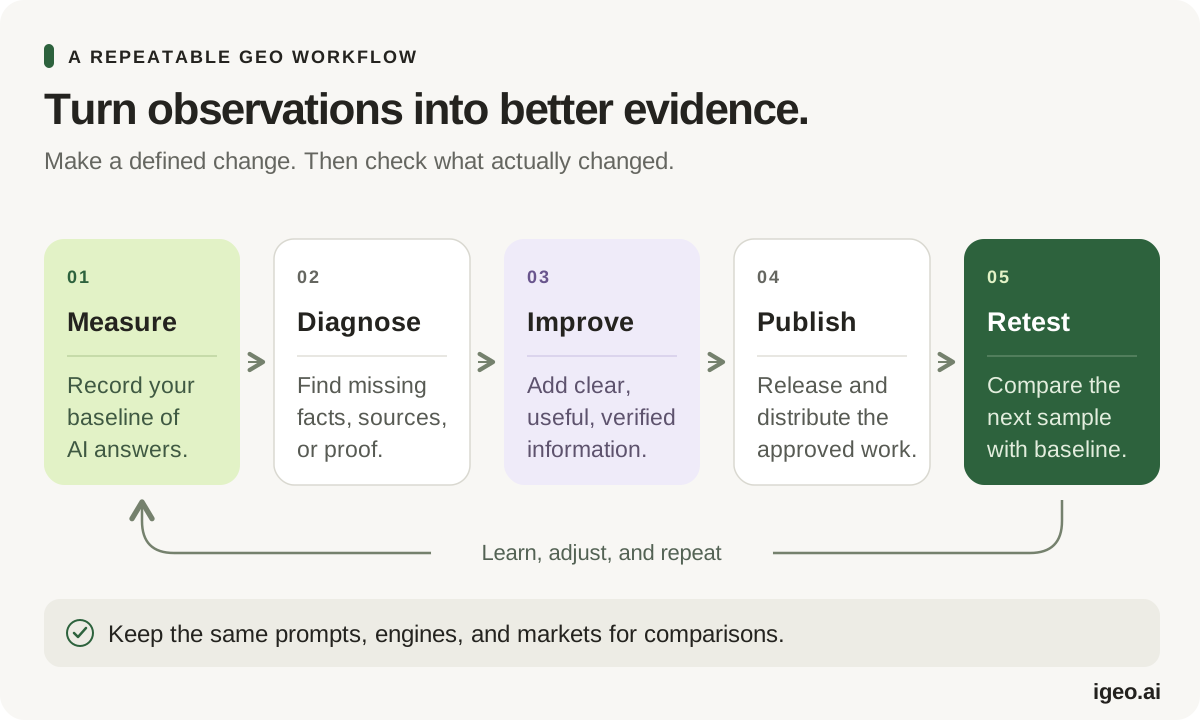
Log what changed, which URLs changed, and when the work went live. Rerun the same prompt set under comparable conditions. Keep new exploratory prompts in a separate group until they have their own baseline.
Look for repeated changes in the relevant answers. If your integration page starts receiving citations but demo visits stay flat, investigate the answer’s context and the landing page rather than claiming a revenue win. If nothing changes, revisit the hypothesis: perhaps the missing evidence belongs on another page, or the observed answers rely on sources you have not addressed.
Deliverable: a decision to continue, revise, or stop the experiment, with the observations that support it.
How to measure GEO without confusing visibility and revenue
Use a small set of clearly defined metrics. The definitions below are an example measurement convention for your own tracked sample, not universal industry standards.
| Metric | Suggested definition |
|---|---|
| Brand mention rate | Answers that name your brand ÷ all eligible observed answers × 100 |
| Owned-site citation rate | Answers linking to your domain ÷ all eligible observed answers × 100 |
| Recommendation rate | Answers recommending your offering ÷ observed answers where a recommendation is relevant × 100 |
| Factual accuracy | Checked brand claims that are correct ÷ all checked brand claims × 100 |
| AI referral conversions | Defined conversions from sessions with an identifiable AI referral, reported separately from answer observations |
For a hypothetical sample of 60 answers, 18 brand mentions produce a 30% mention rate. If six answers link to your website, the owned-site citation rate is 10%. Neither figure tells you how many people saw those answers or became customers.
If you report share of voice, name the competitor set and counting rule. Counting each brand once per answer produces a different denominator from counting every occurrence of a brand name. Record zero denominators as “not available,” not a zero performance score.
Combine your sample with first-party reporting:
- Google Search Console: The Generative AI performance report reports impressions in AI Overviews and AI Mode, with page, country, date, and device views. Those data are a subset of Web search reporting; do not add them to Web totals as extra traffic.
- Bing Webmaster Tools: AI Performance provides citation and cited-page reporting across supported Microsoft AI experiences. A citation count is not a ranking or a conversion count.
- Your analytics and CRM: Inspect identifiable referral visits, conversion events, and lead quality. Referrer loss and later direct visits can leave gaps, so avoid presenting tracked sessions as a complete account of AI influence.
The igeo.ai analytics overview shows how visibility findings can sit alongside the business questions your team needs to answer.
Your first 30 days of GEO
Week 1 — Establish the baseline. Pick one audience, one market, and one product. Select a manageable prompt set, record repeated observations, and identify the pages buyers should encounter.
Week 2 — Fix one meaningful gap. Resolve access problems first. Then improve one or two pages where the observed answers expose a clear information or evidence gap. Record exactly what changed.
Week 3 — Publish and distribute. Review the facts, imagery, links, and markup. Publish the improvements and prepare channel-specific posts. Keep an owner responsible for approvals and the schedule.
Week 4 — Review the evidence. Repeat the baseline checks, compare like with like, and review identifiable visits and leads. Choose the next experiment based on what you learned.
Thirty days is a useful planning window, not a promised time to results. A successful first month can be a reliable baseline and a working improvement process, even before a measurable commercial effect appears.
Common GEO mistakes to avoid
- Treating a single answer as a stable ranking. Preserve the answer and repeat the observation before drawing conclusions.
- Publishing a page for every slight prompt variation. Consolidate genuinely overlapping questions into useful resources.
- Replacing evidence with confident wording. A stronger claim is not a substitute for a better source.
- Turning every finding into a new article. Sometimes the right fix is a product detail, integration document, comparison table, or broken link.
- Counting a mention as a customer. Report answer visibility and business outcomes separately, then investigate the relationship.
- Buying a supposed technical shortcut. Google says special AI files such as
llms.txtare unnecessary for its search visibility. Source: Google’s AI optimization guide.
Put the workflow into practice
Choose one buyer question your team needs to answer well. Save the current generated answers, identify the missing evidence, and give one person ownership of the improvement. That is enough to begin a useful GEO experiment.
To see the process in context, explore the igeo.ai platform, request a free visibility report, or book a demo using your own brand and buyer questions.
Reference and image credit: This original guide was informed by the topic covered in Semrush’s Generative Engine Optimization guide. The Perplexity example is credited above; the workflow, diagrams, and igeo.ai application examples are developed for this article. Platform-specific guidance is linked to primary sources throughout.
Frequently asked questions
What is generative engine optimization?
Generative engine optimization, or GEO, is the practice of improving how a brand and its information appear in AI-generated answers. It combines accessible, useful content with observation of whether a brand is mentioned, cited, accurately described, or recommended for relevant buyer questions.
Does GEO replace SEO?
No. GEO adds an answer-level view to an existing search program. Keep technical SEO, useful pages, internal links, and conversion measurement in place. Add a repeatable process for inspecting generated answers and addressing gaps in the information buyers receive.
What is the difference between GEO and AEO?
AEO, or answer engine optimization, is a broad term for improving visibility in answer-based experiences. GEO focuses on generative answers that synthesize information. The terms overlap; define which engines, questions, markets, and outcomes your team actually measures.
How should a small team start with GEO?
Choose one product or service, one market, and a small set of real buyer questions. Record repeated answers, mentions, and citations. Improve one or two important pages using verified information, then rerun the same questions. A focused pilot is easier to interpret than changing the entire site at once.
Can I allow ChatGPT search while opting out of training?
OpenAI documents independent controls for OAI-SearchBot, which supports search discovery, and GPTBot, which may collect training content. Configure each according to your policy and check firewall access as well as robots.txt. Allowing search access does not guarantee that a page will be cited.
Do FAQs or JSON-LD guarantee AI visibility?
No. Useful FAQs help readers, and accurate JSON-LD describes visible content. Neither guarantees citations or rankings. Google retired FAQ rich results in May 2026, so FAQPage markup should not be presented as a way to earn that search feature.
How do you measure GEO results?
Track brand mentions, owned-site citations, factual accuracy, and recommendations within a fixed set of answer observations. Separately measure platform-reported impressions, identifiable AI referral visits, and conversions. Record the denominator, engine, market, and collection method so comparisons remain meaningful.
How long does GEO take to work?
There is no universal timeline. Discovery, recrawling, answer generation, and buyer decisions happen on different schedules. Use the first 30 days to establish a baseline, publish focused improvements, and begin repeated checks. Treat that as a learning period, not a promise of traffic or revenue growth.