
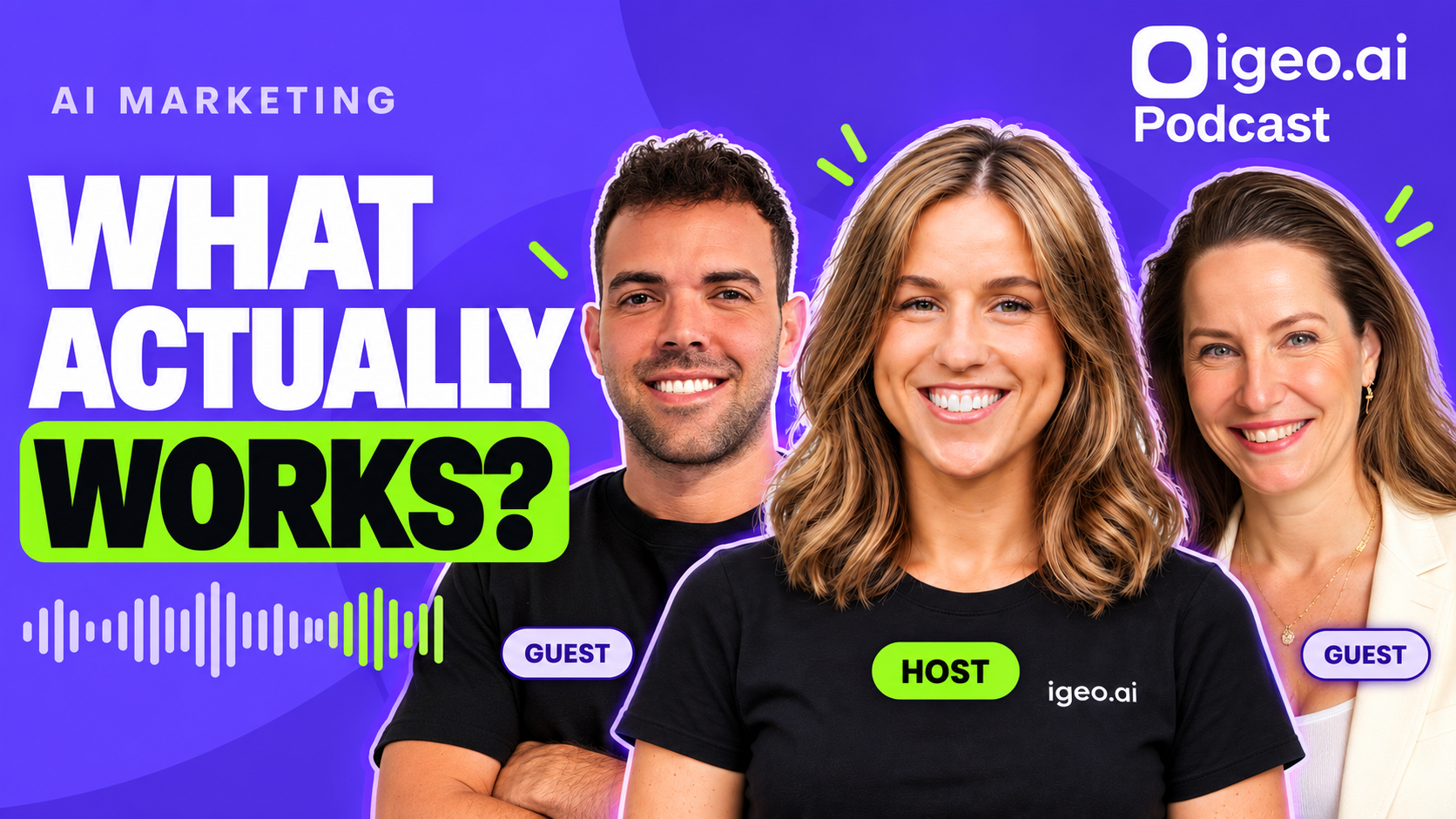
AI agents can help marketing teams research, analyze, and execute more effectively. Their value depends on the quality of the data, the clarity of the task, and the people responsible for the outcome. That is the central theme of the first igeo.ai podcast episode, Can AI Agents Replace Your Marketing Team?
Host Shira Ostrinsky brings together Shira Levy Barkan, marketing and growth strategist, and Orel Emil Ohayon, co-founder and CEO of igeo.ai, for a practical conversation about AI marketing. They discuss where automation helps, why brand visibility matters, and how to connect AI activity to marketing performance.
This article summarizes the conversation and finishes with a practical measurement workflow inspired by it. The workflow is our editorial application of the discussion, rather than a reported customer case study.
Watch the full podcast
Watch the 47-minute conversation below, or use the timestamped links to jump to a topic on YouTube.
| Topic | Jump to the conversation |
|---|---|
| Where marketing agents help—and where people matter | 01:35 |
| Connecting brand and performance | 06:42 |
| Measuring AI marketing results | 08:23 |
| Brand visibility in AI search | 13:16 |
| Finding an unexpected audience on Reddit | 16:40 |
| Research, analytics, and challenging recommendations | 22:12 |
| Product marketing and authenticity | 29:15 |
| Checking your brand’s AI visibility | 35:28 |
| First steps for CMOs adopting AI | 43:33 |
AI agents need a defined job and a responsible owner
Shira Levy Barkan opens with a challenge to the idea that a company can simply replace its marketing team with a few agents. In her experience, agents work best when their responsibilities are specific, their instructions are clear, and they have the information needed to complete the task.
Repetitive operational work is a promising starting point. Strategic decisions require context: who the customer is, what the business is trying to achieve, what the brand can credibly promise, and which tradeoffs are acceptable.
Orel adds that introducing AI can initially create more work. Employees must learn new tools, integrate them into existing processes, and manage additional outputs. An agent is useful when that effort translates into better execution. Simply adding another tool does not establish its value.
Both speakers return to human oversight. Give an agent a bounded task, appoint someone to review its output, and decide what successful completion looks like before expanding its role. Review time and operating costs belong in that evaluation too.
AI performance connects brand visibility to business results
For Shira Levy Barkan, a CMO must connect brand building, execution, and commercial targets. She describes the difficulty of evaluating many separate AI tools while keeping sight of the full customer journey.
At 08:23, the conversation turns to measurement. Brand mentions and a stronger presence in AI answers can signal progress. Qualified leads are a more direct test of whether that progress matters to the business.
In this article, AI performance means the brand’s performance in AI-generated answers and the marketing outcomes associated with that presence. It is broader than counting mentions, and different from measuring an AI model’s speed or benchmark accuracy.
A useful measurement framework separates three questions:
- Visibility: Does the brand appear when people ask relevant questions? Which competing brands and sources appear alongside it?
- Engagement: Do people reach the website, explore relevant pages, or take a next step?
- Business outcomes: Are those interactions producing qualified inquiries, opportunities, or customers?
These are connected signals, but they are not interchangeable. A mention does not prove a visit, and a visit does not prove a sale. For a repeatable approach, use our step-by-step guide to measuring AI search visibility.
AI search makes the buyer’s question more important
The speakers describe a change in how people discover brands. Instead of comparing a long list of search results themselves, buyers can ask an AI assistant to explain the options and recommend a shortlist.
That makes the quality of the information surrounding a brand important. Does the website explain the product clearly? Does the content answer the customer’s actual problem? Is the same brand story supported across relevant channels?
Orel suggests a simple starting point: ask an AI system a question that a potential customer would ask and inspect the answer. Does your brand appear? Is the description accurate? What information seems to be missing?
Treat this as a diagnostic exercise. An AI assistant’s explanation of why it did or did not recommend a company is a hypothesis to investigate, not proof of the system’s ranking process. A reliable baseline needs repeated checks across a consistent set of questions and relevant AI systems.
The Reddit example: follow evidence about your audience
One of the most concrete moments comes when Shira Levy Barkan describes discovering that an audience she had not expected to find on Reddit was active there. She says that working with that channel subsequently brought leads.
The lesson is to test assumptions about where buyers spend time. A channel that feels unlikely may still influence a specialist audience. Its usefulness depends on the people, questions, and conversations found there.
For a marketing team, the next step is to examine the actual discussions and sources around its category. Contribute useful information where appropriate, adapt the message to the setting, and track whether the effort leads to relevant engagement. The episode presents one team’s experience; it does not establish that every brand will get the same result from Reddit.
Research and analytics are valuable when they lead to action
Shira Levy Barkan identifies research and analytics as areas where AI has changed how she works. Faster analysis can reveal patterns and help teams explore questions that previously required more time or specialist support.
Orel emphasizes the next step: execution and feedback. A report becomes useful when someone understands the finding, chooses an action, and checks what happens afterward.
The speakers also discuss challenging recommendations. Before acting, ask:
- What evidence supports this recommendation?
- Why does it matter for our audience and business objective?
- What alternatives were considered?
- What would we measure to decide whether it worked?
Shira distinguishes straightforward, repeatable improvements from strategic changes requiring investment and prioritization. Once a process has been reviewed and proven useful, more of it may be automated. Accountability for consequential decisions still belongs to people.
AI already decides how your brand shows up.
Every prompt, citation, and recommendation is a signal. igeo.ai turns that behavior into clear answers and the next action, whether that’s a page to rewrite, a schema to add, or a story to publish.
Product knowledge and authenticity become more valuable
The conversation connects product marketing to brand trust. Buyers want to understand whether a product fits their company, their audience, and their specific challenge. General claims about being the best are less useful than a clear explanation of how something works and who it serves.
The speakers also emphasize the human voice behind the brand. Content teams and subject-matter experts can contribute experience, judgment, and product knowledge that a generic draft does not supply on its own.
For marketers, that points toward practical content: real use cases, accurate comparisons, demonstrations, answers to customer questions, and explanations from people who know the product. AI can help prepare that work, while the team checks its accuracy and adds the experience that makes it useful.
Put the discussion into practice: an AI marketing performance workflow
The following workflow turns the episode’s themes into a manageable starting point. It is a suggested process, not a promise of a particular visibility or revenue increase.
1. Choose a business objective and a buyer question
Begin with a concrete outcome, such as generating qualified demo requests from a particular audience. Identify the questions that audience asks before choosing a solution. Keep the initial scope small enough to review consistently.
2. Establish a visibility baseline
Run a fixed set of questions through the AI systems relevant to your customers. Record the date, model or experience, question, response, mentions, and cited sources. Keep branded questions separate from questions that do not name your company.
Use igeo.ai Monitoring to explore the monitoring workflow, and retain the underlying answers so changes can be investigated rather than reduced to a single score.
3. Prioritize one evidence-backed improvement
Look for a recurring gap: an unclear product explanation, a missing use case, an outdated fact, or a question that existing content does not answer. Assign an owner and create or update the most relevant page. Have someone with product knowledge review it before publication.
4. Connect visibility work to traffic and leads
Use AI Traffic Analytics alongside your conversion and CRM reporting to investigate the visits and outcomes you can observe. Keep visibility measurements separate from referral and sales data, and avoid treating incomplete attribution as a complete picture of the customer journey.
5. Review results before expanding automation
Repeat the original question set and compare the evidence. Review answer accuracy, relevant mentions, referral engagement, and lead quality. Consider other changes that might have affected the result before attributing improvement to one content update.
Keep the tasks that help, revise the ones that do not, and automate repeatable work only after its quality is understood. That reflects the episode’s recurring advice: learn the tools, ask critical questions, and keep business outcomes in view.
Start with a question your customer would actually ask
The podcast closes with practical advice for CMOs: understand where AI can help, deliberately decide where people remain responsible, and evaluate tools against the work the organization needs to do.
Start with one audience, one objective, and a small set of buyer questions. Give your team a clear way to measure progress and a reason to act on what it learns.
Start for free with igeo.ai to begin exploring your brand’s AI presence, or watch the full conversation on YouTube.
Sources and further reading
- Can AI Agents Replace Your Marketing Team? — igeo.ai Podcast, published October 4, 2026. Episode summary based on the conversation; timestamps link to the original source.
- How to Measure AI Search Visibility: Step-by-Step Guide for 2026 for the detailed measurement method.
- Google Search Central: AI features and your website. Google recommends accessible, helpful content and structured data that matches the page; no special AI schema is required, and inclusion is not guaranteed.
Frequently asked questions
Can AI agents replace a marketing team?
In this episode, Shira Levy Barkan and Orel Emil Ohayon argue that AI agents can support repetitive tasks, research, reporting, and execution, but experienced people still need to own strategy, review important outputs, and make consequential decisions. The value of an agent depends on its task, data, instructions, and supervision.
What is the difference between AI marketing and AI performance?
AI marketing is the use of AI to support marketing activities such as research, content, analysis, and campaign execution. In this article, AI performance means evaluating the results: how a brand appears in AI answers, what traffic and qualified leads follow, and whether the work improves business outcomes. It does not mean model speed or technical benchmark performance.
How should marketers measure AI search visibility?
Use a consistent set of buyer questions across the AI systems relevant to your audience. Record brand mentions, cited sources, competitors, answer accuracy, and the date and context of each run. Repeat the checks, then evaluate referral traffic and conversions separately. A single answer is a useful spot check, not a complete visibility baseline.
Why does human oversight matter in AI marketing?
AI can produce inaccurate analysis or recommendations that overlook business context. People should verify evidence, protect brand accuracy, and decide which actions deserve investment. The speakers recommend asking why a recommendation was made, what supports it, and what alternatives exist before expanding automation.
What should a CMO do first when adopting AI?
Start with business objectives, decide where AI can help and where people must remain responsible, and choose a limited workflow to evaluate. Give the system relevant data, assign an owner, define success, and review the results before expanding to more tasks.
Does adding FAQs or schema guarantee AI citations?
No. Clear answers and accurate structured data help describe your content, but they do not guarantee indexing, rankings, or AI citations. Google says its AI search features do not require special schema or additional AI-specific markup. Focus on useful, accessible content and measure actual outcomes.