

Half of consumers use AI-powered search today, and it stands to impact $750 billion in revenue by 2028–what is your strategy and activation plan for gen AI engine optimization?
McKinsey
The way people search online is changing faster than it has in the last 20 years.
For decades, traditional search engines like Google were the default “gateway” to the internet. Users typed keywords, scanned blue links, and clicked through to websites. Entire industries were built on this model. SEO became a core marketing discipline. Performance marketing scaled on top of it. Content teams optimized every page to rank higher in search results.
But now, a new search paradigm is rapidly taking over.
Instead of browsing results, users are asking questions — and expecting full answers.
They are using ChatGPT, Google AI Overviews, Perplexity, Gemini, Copilot, Claude, and other AI-driven tools to find products, make decisions, and discover brands. This isn’t a future trend. It’s happening right now.
McKinsey recently published a powerful report calling AI Search the “new front door to the internet.” And they are absolutely right.
AI is no longer just a tool. It is becoming the primary interface between consumers and brands.
The big question is:
If AI is the new front door… will your brand show up when customers walk in?
This article breaks down what McKinsey discovered, why AI Search will reshape consumer behavior, and what your company must do today to become the brand that AI recommends tomorrow.
AI Search Is Not Just a Feature — It’s a Behavioral Shift
McKinsey’s report highlights a critical insight:
AI Search is fundamentally changing how users navigate the internet.
Instead of searching for ten links and choosing one, people increasingly want:
- One trusted answer
- One recommendation
- One summarized decision
- One final conclusion
AI tools reduce friction, save time, and deliver “decision-ready” information.
This creates a massive shift:
Old Search (Google Era)
Users asked:
“What are the best project management tools?”
Then they:
- clicked multiple results
- opened 10 tabs
- read reviews
- compared pricing pages
- eventually decided
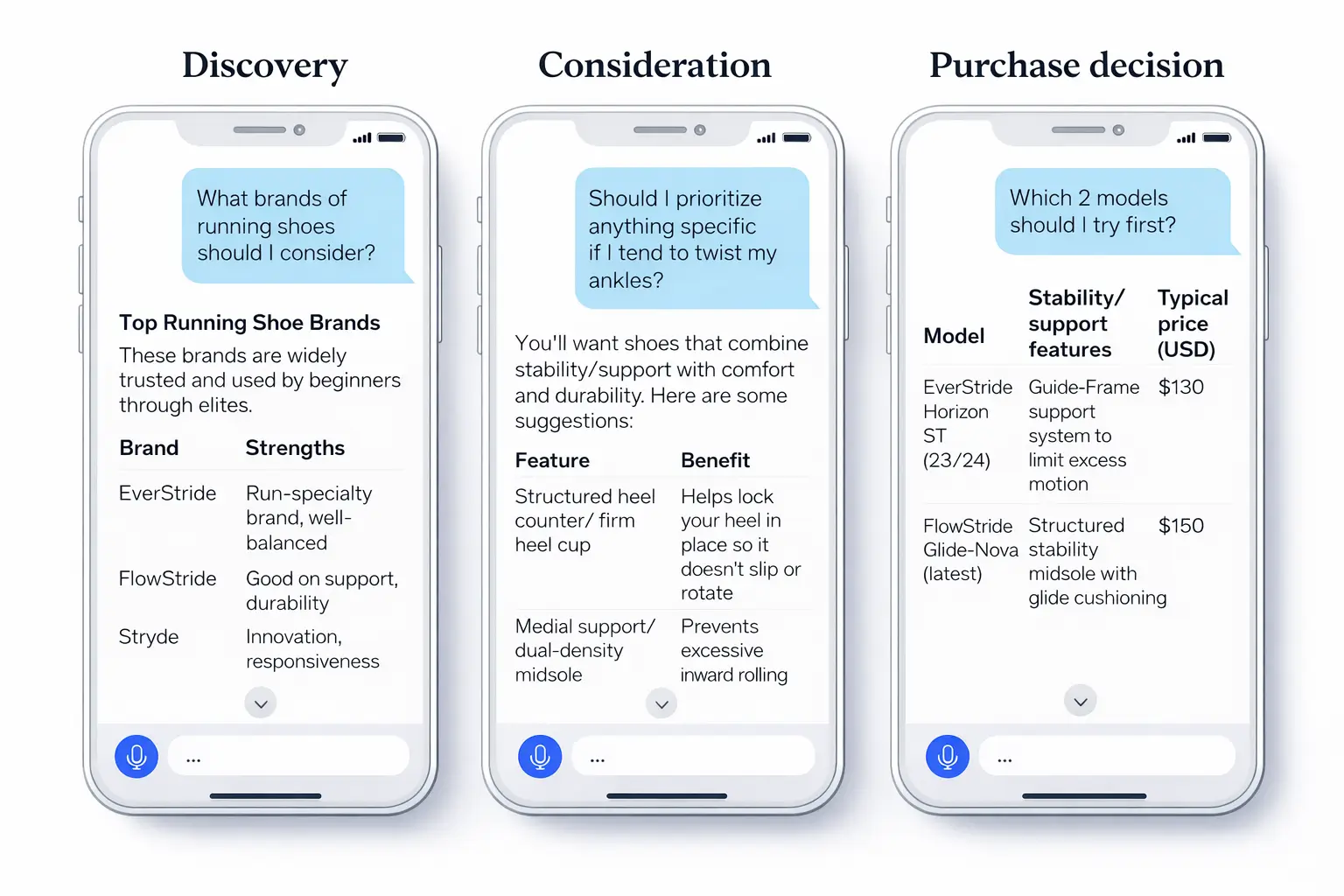
New Search (AI Answer Engine Era)
Users ask:
“What is the best project management tool for a remote team of 20 people in Europe?”
And the AI answers with:
- 3 recommendations
- pricing comparisons
- pros and cons
- final suggestion
This is not search.
This is delegated decision-making.
And if your brand isn’t in the AI answer, you don’t exist in that moment.
McKinsey’s Core Message: AI Is Becoming the Primary Customer Journey
McKinsey describes AI Search as a new entry point to the web — a new “front door.”
That’s a major statement, because it implies:
AI is not replacing search engines only.
AI is replacing:
- comparison sites
- blogs
- review platforms
- affiliate websites
- YouTube research
- even brand websites in some cases
People want instant answers. And AI gives them that.
McKinsey also highlights that AI Search will impact hundreds of billions of dollars in revenue as consumer discovery shifts from traditional channels into AI-driven interfaces.
This means that in the next few years:
Brands will fight not for Google rankings — but for AI recommendations.
And that requires an entirely new marketing discipline.
The Rise of “Answer Engines” Instead of Search Engines
A key concept emerging in the industry is the idea of Answer Engines.
Tools like ChatGPT, Perplexity, Gemini, and AI Overviews don’t just “search.” They synthesize.
They gather information from:
- web content
- knowledge bases
- structured data
- product listings
- brand websites
- public reviews
- Reddit and community content
- press releases
- Wikipedia-like sources
- industry reports
Then they generate a single response.
That response becomes the new “top of funnel.”
And the winner is the brand that gets included in the answer.
This is where SEO becomes insufficient.
SEO is about ranking web pages.
But AI Search is about being cited, mentioned, recommended, and trusted across multiple AI systems.
This is where the new discipline is born:
Generative Engine Optimization (GEO)
GEO is the process of optimizing your brand presence so that AI models recognize your company as relevant and credible enough to mention when users ask questions.
And GEO is becoming the new competitive advantage.
The Biggest Risk: Brands Are Losing Visibility Without Realizing It
One of the most dangerous aspects of this shift is that it happens quietly.
Your SEO traffic might still look stable today.
Your Google rankings might still be strong.
Your paid ads may still deliver conversions.
But at the same time, AI tools may already be reducing your visibility because users are no longer clicking.
They are staying inside AI-generated answers.
Meaning: fewer visits, fewer clicks, fewer sessions.
This is the new reality:
AI Search is stealing the customer journey.
Even worse:
Most companies don’t have tracking systems to measure AI visibility.
They don’t know:
- how often they appear in ChatGPT answers
- whether Perplexity cites them
- if Gemini recommends competitors instead
- what prompts customers use
- why their brand isn’t being mentioned
- which content assets influence AI recommendations
So brands are flying blind into the most important marketing shift of the decade.
The AI Search Era Creates a New Type of Marketing Battlefield
McKinsey’s report makes it clear: the next marketing battleground is not Google.
It’s AI.
And AI changes the rules.
In traditional SEO, you could win with:
- backlinks
- keywords
- on-page optimization
- technical SEO
- content volume
But in AI Search, the algorithm is not ranking pages.
It’s generating answers.
So the question becomes:
What does AI trust?
AI models prioritize:
- authority sources
- structured and consistent information
- frequently cited brands
- verified data
- reviews and community sentiment
- repeated mentions across credible domains
- clarity of positioning
In other words, AI rewards the brands that are well understood and widely referenced across the internet.
Why This Will Reshape E-Commerce and B2B Buying Behavior
McKinsey emphasizes that AI Search is not just for curiosity queries.
It’s already impacting high-intent purchase journeys.
Consumers are using AI to:
- compare products
- find alternatives
- ask for recommendations
- evaluate pricing
- check brand trustworthiness
- decide what to buy
In B2B, the impact may be even bigger.
B2B buyers now ask AI tools:
- “What CRM is best for healthcare startups?”
- “What are the best SOC 2 compliance platforms?”
- “What’s the best AI visibility monitoring tool?”
- “Which HR platform works best for 500 employees?”
And AI gives them a shortlist.
This means AI Search is compressing the funnel.
Instead of 20 vendors competing for attention, the AI might mention 3.
And if your company is not in the top 3, you lose the deal before it even starts.
The Future of Marketing Is Not SEO — It’s GEO
Traditional SEO is still important.
But SEO is now a subset of a larger system.
Because the buyer journey has expanded into multiple AI platforms:
- ChatGPT
- Perplexity
- Gemini
- Copilot
- Claude
- Google AI Overviews
- Meta AI
- voice assistants
- autonomous AI agents
Each model has different behaviors.
Each cites different sources.
Each recommends brands differently.
So brands need a new strategy:
Generative Engine Optimization (GEO)
GEO means optimizing how AI models interpret your brand across the web.
It includes:
- improving AI citations
- shaping AI brand narratives
- ensuring correct messaging
- boosting AI trust signals
- tracking competitor recommendations
- understanding what prompts trigger your brand
- measuring AI visibility performance
And this is exactly where iGEO becomes essential.
Introducing iGEO: The GEO Platform Built for AI Search Visibility
iGEO is a Generative Engine Optimization platform designed to help brands win visibility in the AI Search era.
If McKinsey is right — and AI Search becomes the new front door — then iGEO is the system that helps brands become the “default recommendation” inside that door.
iGEO helps companies answer critical questions like:
- Does ChatGPT recommend my brand?
- Is my competitor being cited more than me?
- What prompts trigger AI recommendations in my category?
- How does my brand sentiment appear across AI models?
- Which sources influence AI answers?
- How can I improve my AI visibility score?
- How do I measure GEO ROI?
The key problem iGEO solves is simple:
AI Search is rewriting your marketing funnel — and iGEO gives you control over it.
What Makes AI Search Optimization So Hard?
Many brands assume they can just “do SEO better.”
But GEO is not SEO.
AI models do not behave like Google.
They are trained on massive datasets, constantly updated, and influenced by many sources beyond your website.
For example, AI may cite:
- a competitor’s press release
- an outdated blog post
- a third-party review site
- Reddit threads
- YouTube transcripts
- Wikipedia entries
- directory listings
- industry research papers
This creates a huge challenge:
AI might mention your brand incorrectly.
Or worse:
AI might not mention your brand at all.
And you may never know.
That’s why iGEO exists: to give brands visibility into the AI-driven world.
iGEO Core Features: How Brands Actually Win AI Visibility
To win in AI Search, companies need three capabilities:
- Measurement
- Optimization
- Execution
iGEO delivers all three.
1. AI Visibility Monitoring Across Multiple Models
One of iGEO’s most powerful features is its ability to test and monitor brand presence across multiple LLMs.
Instead of guessing what AI says about you, iGEO allows you to track:
- brand mentions
- citations
- recommendation frequency
- sentiment
- category positioning
- competitor comparisons
This is critical because each model behaves differently.
ChatGPT might recommend one set of brands.
Perplexity might cite entirely different sources.
Google AI Overviews might summarize competitors instead.
iGEO gives you a unified visibility dashboard across all of them.
2. Prompt Intelligence: Understand What Customers Ask AI
The new keyword is not a keyword.
It’s a prompt.
Customers don’t search:
“best CRM software”
They ask:
“What is the best CRM for a startup that sells to enterprise clients?”
This means the new SEO keyword research is prompt research.
iGEO tracks and analyzes:
- the prompts people use in your industry
- what intent they represent
- which prompts trigger competitor mentions
- which prompts AI fails to mention your brand
This is what we call Prompt Intelligence.
And it becomes the most valuable dataset in modern marketing.
3. Competitive Benchmarking: Track Who AI Recommends Instead of You
In the AI Search era, your competition is not based on who ranks above you on Google.
Your competition is who AI mentions first.
That means your competitor analysis must change.
iGEO shows you:
- your competitors’ AI visibility scores
- what prompts they dominate
- which websites and citations support their recommendations
- how to outrank them inside AI answers
This creates a new KPI:
AI Market Share
If AI recommends your competitor more often than you, your funnel is shrinking.
And iGEO makes that measurable.
4. Content Strategy Built for AI Citations (Not Just Traffic)
McKinsey’s report highlights that AI will increasingly summarize content instead of sending traffic to websites.
So content marketing needs to evolve.
Instead of writing content only for Google, brands must write content that AI models can:
- interpret
- trust
- cite
- summarize correctly
iGEO helps brands identify content gaps and generate GEO-optimized content strategies.
This includes:
- high-authority pages
- structured FAQ content
- comparison pages
- category pages
- product explanation content
- thought leadership assets
The goal is not “ranking.”
The goal is:
becoming the most quotable and trustworthy source in your category.
5. AI Reputation & Sentiment Control
AI models don’t just recommend based on features.
They recommend based on perceived trust.
If AI “believes” your brand is risky, outdated, overpriced, or irrelevant — you lose.
iGEO helps brands monitor sentiment and narrative across AI platforms, allowing you to detect issues early such as:
- negative framing
- missing credibility signals
- wrong product descriptions
- outdated information
- incorrect positioning
This is similar to brand reputation management — but for AI engines.
How to Build a Winning AI Search Strategy (McKinsey + iGEO Framework)
Based on McKinsey’s insights and what we see across the market, the winning AI Search strategy includes five stages:
Step 1: Accept That AI Is the New Top of Funnel
The first step is mindset.
AI is not an experiment.
AI is becoming the default consumer research tool.
Brands must treat AI as:
- a distribution channel
- a recommendation engine
- a reputation layer
- a discovery platform
This means AI visibility is now a marketing KPI.
Step 2: Audit Your Current AI Visibility
Before you can improve, you must measure.
Brands should run an AI visibility audit to answer:
- Do AI engines mention us at all?
- Are we cited correctly?
- Are we recommended in high-intent prompts?
- Are competitors dominating AI answers?
iGEO automates this audit.
Step 3: Build Your AI Trust Footprint
AI engines rely on trust signals.
Your trust footprint includes:
- structured website content
- consistent brand messaging across the web
- authoritative citations
- strong reviews
- presence in credible publications
- high-quality knowledge hubs
This is the foundation of GEO.
Step 4: Optimize Content for AI Comprehension and Citation
Your content must be written in a way AI understands.
This includes:
- clear definitions
- structured formatting
- bullet points and tables
- FAQ sections
- comparison pages
- schema markup
- consistent terminology
iGEO helps brands identify what content assets are missing and what needs to be improved.
Step 5: Track, Improve, and Scale
AI Search changes fast.
Your GEO strategy cannot be “one and done.”
Brands need ongoing monitoring and optimization.
This is where iGEO becomes a long-term growth platform.
The Biggest Opportunity: AI Search Can Become Your Highest-Converting Channel
Here’s the part most marketers miss:
AI traffic is not like Google traffic.
AI-driven users are often deeper in the decision funnel.
They arrive with:
- higher intent
- clearer needs
- more trust in the recommendation
This means that brands who win AI Search often see:
- higher conversion rates
- lower CAC
- shorter sales cycles
- better quality leads
McKinsey suggests AI will reshape revenue distribution.
That means early movers can dominate market share before competitors even realize what happened.
Final Thought: AI Will Choose the Winners — Unless You Optimize for It
McKinsey’s report is a warning and an opportunity.
AI Search is becoming the new front door to the internet.
And that means brands have two options:
Option 1: Wait and lose visibility slowly.
Your competitors get recommended.
Your traffic declines.
Your funnel becomes weaker.
Your brand becomes invisible inside AI answers.
Option 2: Build your GEO strategy now.
Measure your AI visibility.
Optimize your content.
Control your brand narrative.
Earn AI trust.
Become the recommended brand.
This is not about future-proofing.
This is about staying relevant.
Why iGEO Is the Platform Brands Need to Win AI Search
AI Search is not one platform.
It is an ecosystem.
And brands need a unified system to track and optimize their visibility across it.
That’s exactly what iGEO delivers.
iGEO is built to help brands:
- Monitor AI visibility across all major LLMs
- track prompts and intent signals
- benchmark against competitors
- improve citations and recommendations
- optimize content for AI engines
- increase AI-driven conversions
In the same way, SEO tools defined the Google era…
iGEO is defining the AI Search era.
If AI Is the New Front Door… Make Sure Your Brand Is Standing at the Entrance
McKinsey’s research is clear:
AI Search is reshaping how people discover products, services, and brands.
The brands that win in 2026 won’t be the ones with the biggest ad budget.
They’ll be the ones who become the default answer inside AI engines.
And that’s the new game.
The companies who understand GEO early will dominate.
The ones who ignore it will disappear quietly.
If you want to start winning AI Search today, the first step is simple:
FAQ: AI Search, GEO, and iGEO
What is AI Search?
AI Search refers to search experiences powered by large language models (LLMs), where the user receives an answer instead of a list of links. Examples include ChatGPT, Perplexity, Google AI Overviews, Gemini, and Copilot.
What is Generative Engine Optimization (GEO)?
GEO is the practice of optimizing your brand’s visibility inside AI-generated answers. It includes improving citations, trust signals, content structure, and AI recommendation performance.
How is GEO different from SEO?
SEO focuses on ranking web pages on search engines. GEO focuses on being mentioned and recommended inside AI answers across multiple AI platforms.
Why is AI Search important for marketers?
AI Search is becoming the first touchpoint in the customer journey. If your brand is not visible in AI answers, you lose discovery opportunities and revenue.
What is iGEO?
iGEO is a GEO platform that helps brands monitor, analyze, and optimize their visibility across AI-driven search engines like ChatGPT, Gemini, Perplexity, and Google AI Overviews.
How can I track my brand visibility in ChatGPT?
ChatGPT does not provide a native visibility dashboard. Platforms like iGEO track brand mentions, citations, prompts, and competitive visibility across AI models.